
Dark spots can appear after a breakout, years of sun exposure, inflammation, irritation or other changes in the skin. Although these areas of discoloration are often grouped together under the term hyperpigmentation, they do not necessarily have the same cause—and that means they should not automatically be treated the same way.
So, what is the best treatment for hyperpigmentation?
The answer depends on what caused the pigmentation, how the discoloration appears, the condition of the surrounding skin and whether other concerns such as acne, congestion or uneven texture are also present.
Professional chemical peels such as BioRePeel, DMK Enzyme Therapy and other customized skin treatments may help certain types of hyperpigmentation, but the first step is understanding what kind of pigmentation you are actually dealing with.
Why Am I Getting Dark Spots on My Face?
You may have hyperpigmentation without knowing that's what it is called.
Maybe you've noticed brown spots appearing on your cheeks, patches of skin that look darker than the surrounding area, or dark marks that remain for weeks or months after a pimple disappears. You might notice that your skin tone looks increasingly uneven, that old acne breakouts leave brown marks behind, or that certain spots become more noticeable after spending time in the sun.
People often describe these changes by asking:
- Why am I getting dark spots on my face?
- Why do my pimples leave dark marks after they heal?
- What are the brown spots appearing on my cheeks?
- Why do I have dark patches on my skin?
- Why won't my acne marks go away?
- What is it called when acne leaves dark spots?
- Why is my skin tone becoming uneven?
- Are these dark spots acne scars or hyperpigmentation?
- Why do my dark spots get worse in the sun?
Many of these visible changes fall under the broad category of hyperpigmentation, which simply means that an area of skin has become darker than the surrounding skin because of increased or uneven pigment.
The cause, however, is what really matters.
A flat brown mark left behind after a pimple may be post-inflammatory hyperpigmentation (PIH). Spots that have developed gradually after years of UV exposure may be related to sun damage. Darker patches can have other causes, including melasma, which is a separate pigmentation condition and is not treated at Agnes Beauty & Wellness.
So if you've been searching for how to get rid of dark spots, brown spots, acne marks or uneven skin tone, you may actually be looking for information about hyperpigmentation—even if you've never heard that term before.
The next step is figuring out why the discoloration developed, because different types of dark spots can require different treatment approaches.
What Is Hyperpigmentation?
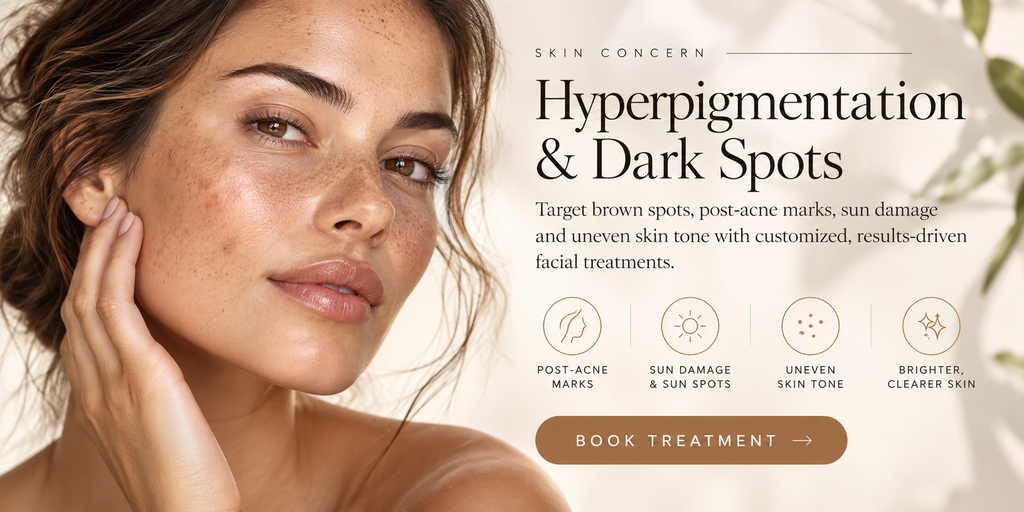
Hyperpigmentation is a general term used to describe areas of skin that become darker than the surrounding skin.
Our skin gets its color primarily from a pigment called melanin, which is produced by cells called melanocytes.
When melanin production increases or pigment becomes unevenly distributed, an area of skin can appear darker.
Hyperpigmentation can affect a small spot, multiple areas of the face or larger patches of skin. Depending on the cause and skin tone, the discoloration may appear:
- light brown
- dark brown
- tan
- gray-brown
- reddish-brown
- darker than the surrounding complexion
Hyperpigmentation itself is not one single skin condition. It is a visible result that can have several different causes.
That distinction becomes important when deciding how to treat it.
What Causes Hyperpigmentation?
Several things can trigger excess pigment production or cause pigmentation to become more noticeable.
Sun Exposure
Ultraviolet radiation stimulates melanin production.
This is part of the skin's natural response to UV exposure, but repeated sun exposure over many years can contribute to uneven pigmentation and visible sun spots.
This is why pigmentation often becomes more noticeable on areas that receive frequent sun exposure, including the:
- face
- forehead
- cheeks
- nose
- décolletage
- hands
Living in Southern California makes consistent sun protection particularly important when trying to improve pigmentation.
Acne and Skin Inflammation
A breakout can disappear while leaving a dark mark behind.
This is called post-inflammatory hyperpigmentation, or PIH.
PIH occurs when inflammation stimulates excess pigment production during the skin's healing response.
Acne is one of the most common causes, but PIH can also develop after other forms of skin inflammation or injury.
If acne is still active, controlling the breakouts is important because every new inflammatory lesion can potentially create another dark mark.
For a complete explanation of acne types and treatment options, read How to Treat Acne: Causes, Types & the Best Treatments for Breakouts
Picking or Squeezing Pimples
Picking at acne can increase inflammation and trauma to the skin.
That can make post-acne discoloration more noticeable and may also increase the risk of true acne scarring.
A pimple that might otherwise have resolved can therefore leave behind a much longer-lasting reminder.
Skin Irritation or Injury
Inflammation caused by irritation, burns, aggressive skincare or other forms of skin injury can sometimes result in post-inflammatory pigmentation.
This is one reason aggressive treatment is not always better when trying to correct discoloration.
Hormonal Pigmentation and Melasma
Melasma can cause symmetrical brown or gray-brown patches, commonly on areas such as the cheeks, forehead and upper lip.
Although melasma involves pigmentation, it is not the same thing as an ordinary sun spot or a dark mark left behind by acne.
Hormonal influences, sun exposure and other factors can contribute to melasma, and it can be particularly persistent.
Agnes Beauty & Wellness does not treat melasma.
If you suspect that your pigmentation may be melasma, I recommend seeking evaluation from a dermatologist or other qualified medical provider rather than assuming that a facial or peel is the appropriate treatment.
What Are the Different Types of Hyperpigmentation?
Understanding what caused the discoloration helps determine what type of treatment may be appropriate.
Post-Inflammatory Hyperpigmentation (PIH)
PIH develops after inflammation or injury to the skin.
Acne is a common trigger.
After the pimple heals, the skin may be completely flat but remain brown, reddish-brown or darker than the surrounding skin.
This is pigmentation—not necessarily a scar.
Post-Acne Dark Spots
People frequently call every mark left behind by acne an "acne scar."
But a flat dark spot and a depressed acne scar are different problems.
A dark spot primarily involves pigmentation.
A depressed or raised scar involves a structural change in the skin.
That distinction matters because treatments designed to improve pigmentation are not necessarily the same treatments used to improve structural acne scars.
Sun Spots
Sun spots are areas of pigmentation associated with accumulated UV exposure.
They are commonly seen on areas of the skin that have received years of sun exposure.
Sun protection becomes particularly important when treating these areas because continued UV exposure can work against attempts to improve pigmentation.
Uneven Skin Tone
Sometimes there isn't one obvious dark spot.
Instead, pigmentation may contribute to an overall complexion that looks uneven, patchy or less uniform.
In these situations, treatment may need to address both pigmentation and the overall condition and texture of the skin.
What Is the Best Treatment for Hyperpigmentation?
There is no single treatment that is best for every form of hyperpigmentation.
The appropriate treatment depends on factors including:
- the cause of the pigmentation
- whether acne or inflammation is still active
- the condition of the skin barrier
- how sensitive or reactive the skin is
- whether texture or scarring is also present
- the person's current skincare routine
- previous treatments
- sun exposure
For the types of pigmentation Agnes treats, professional options may include BioRePeel and other appropriate chemical peels, DMK Enzyme Therapy and customized facial treatments.
BioRePeel for Hyperpigmentation and Dark Spots
BioRePeel is one of the treatments Agnes may consider when pigmentation occurs alongside concerns such as dullness, uneven tone, post-acne marks or uneven texture.
BioRePeel is a professional chemical peel designed to provide controlled exfoliation and skin renewal.
Depending on the individual, it may be considered for concerns including:
- post-acne dark marks
- hyperpigmentation
- sun-related discoloration
- dull skin
- uneven tone
- rough or uneven texture
- acne-prone or congested skin
This makes BioRePeel particularly relevant when the goal isn't simply to address one isolated dark spot, but to improve several aspects of the complexion at the same time.
Chemical peels are not automatically appropriate for every pigmentation concern or every skin condition. Treatment strength, skin sensitivity, active inflammation and other factors need to be considered.
Learn more about BioRePeel and how the no-peel peel works
You can also explore BioRePeel and Agnes's other results-oriented facial treatments
Can DMK Enzyme Therapy Help Hyperpigmentation?
DMK Enzyme Therapy approaches the skin differently from a conventional chemical peel.
Rather than focusing exclusively on surface exfoliation, DMK treatments are customized around the condition and function of the skin and can be incorporated into a progressive skin-revision program.
DMK may be considered when pigmentation exists alongside concerns such as:
- post-acne discoloration
- uneven-looking skin
- congestion
- compromised-looking skin
- uneven texture
- loss of firmness
- reactive or stressed skin
This can be especially relevant when simply performing increasingly aggressive exfoliation is not the most appropriate approach.
Agnes determines whether DMK is suitable based on the condition of the individual's skin rather than automatically recommending it to everyone with dark spots.
Read What Is DMK Enzyme Therapy?
Or explore DMK Enzyme Therapy and Skin Revision in Huntington Beach
Can Microneedling Help Hyperpigmentation?
Traditional microneedling is primarily valuable when pigmentation exists alongside concerns such as acne scarring, uneven texture, enlarged pores or other textural changes.
This is an important distinction.
If a person says, "I have dark acne scars," we first need to determine whether they mean:
a flat dark mark
or
a true depressed acne scar with a change in skin texture.
If the concern is purely pigmentation, a pigmentation-focused treatment may make more sense.
If acne has left both discoloration and structural textural changes, the overall treatment strategy may be different.
Microneedling is not automatically appropriate for every type of pigmentation, which is another reason the skin should be assessed before choosing a procedure simply because it is popular.
Can Dermaplaning Remove Hyperpigmentation?
Dermaplaning removes dead cells and fine vellus hair from the surface of the skin.
It can leave the complexion looking smoother, brighter and more even, but it is important to understand its limitations.
Dermaplaning does not simply erase deeper pigmentation.
It may be useful when surface dullness and rough texture are contributing to an uneven-looking complexion, but persistent dark spots or post-inflammatory pigmentation may require a more targeted treatment approach.
Learn more about Dermaplaning and Agnes's Deluxe Dermaplane Facial
[/luxury-spa-facials/]
Which Treatment Is Best for Different Types of Hyperpigmentation?
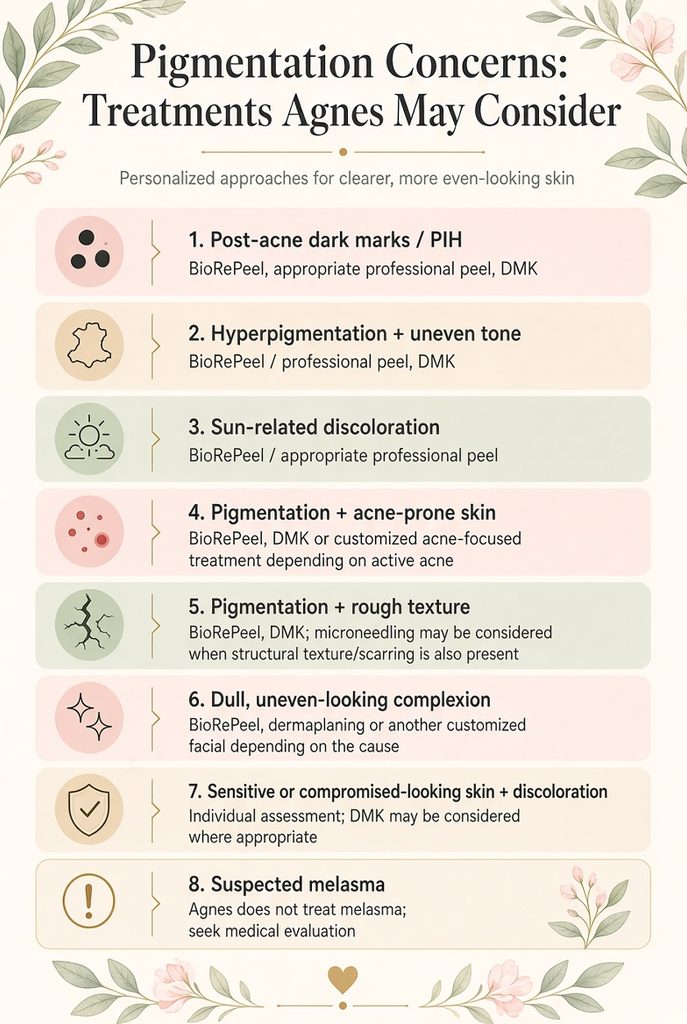
The correct treatment depends on the skin, but the following provides a useful starting point.
| Main Concern | Treatments Agnes May Consider |
|---|---|
| Post-acne dark marks / PIH | BioRePeel, appropriate professional peel, DMK |
| Hyperpigmentation + uneven tone | BioRePeel / professional peel, DMK |
| Sun-related discoloration | BioRePeel / appropriate professional peel |
| Pigmentation + acne-prone skin | BioRePeel, DMK or customized acne-focused treatment depending on active acne |
| Pigmentation + rough texture | BioRePeel, DMK; microneedling may be considered when structural texture/scarring is also present |
| Dull, uneven-looking complexion | BioRePeel, dermaplaning or another customized facial depending on the cause |
| Sensitive or compromised-looking skin + discoloration | Individual assessment; DMK may be considered where appropriate |
| Suspected melasma | Agnes does not treat melasma; seek medical evaluation |
This is why choosing a treatment based solely on the name of a skin concern can be misleading.
Two people can both say they have "hyperpigmentation" while having very different skin and requiring very different approaches.
Hyperpigmentation vs. Acne Scars: What's the Difference?
If a pimple leaves behind a mark, look at the surface of the skin.
If the area is flat but darker than the surrounding skin, you may be looking at post-inflammatory hyperpigmentation.
If the skin has developed a depression, pit, rolling texture or raised area, you may be dealing with a true acne scar.
Some people have both.
This distinction determines whether the treatment should primarily target pigment, skin texture or both.
If acne is still active, start with our complete guide to treating acne and different types of breakouts
Can Hyperpigmentation Go Away on Its Own?
Some forms of post-inflammatory hyperpigmentation can gradually fade as the skin naturally renews itself.
However, the process can take time.
How quickly pigmentation improves depends on factors such as:
- the cause of the pigmentation
- how much inflammation occurred
- the depth of the pigment
- skin tone
- continued sun exposure
- whether new acne or inflammation is creating additional marks
- skincare and treatment
Persistent sun-related pigmentation may behave differently from a temporary mark left after a pimple.
This is another reason it is difficult to give every person the same timeline.
How Long Does Hyperpigmentation Take to Fade?
There is no universal timeline.
A superficial post-acne mark may gradually become less noticeable, while other forms of pigmentation can persist much longer.
Professional treatments may help improve appropriate types of discoloration, but pigmentation correction should generally be thought of as a process rather than an overnight treatment.
Be cautious of treatments or products promising to eliminate all dark spots immediately.
Why Does My Hyperpigmentation Keep Coming Back?
Sometimes the treatment isn't the main problem.
The trigger is still occurring.
For example, if acne continues to create inflammation, new post-inflammatory dark marks can continue appearing even while older ones are fading.
If UV exposure is contributing to pigmentation, treating the skin without consistent sun protection can also work against the goal.
Successful pigmentation management therefore often involves two jobs:
Improve the pigmentation that already exists.
and
Reduce the triggers creating new pigmentation.
How Can I Prevent Hyperpigmentation From Getting Worse?
Wear Sunscreen Consistently
Sun protection is one of the most important parts of managing pigmentation.
UV exposure can stimulate additional melanin production and make existing discoloration more noticeable.
Use a broad-spectrum sunscreen appropriate for your skin and reapply according to the product instructions, particularly when spending significant time outdoors.
Don't Pick at Acne
Picking and squeezing pimples increases trauma and inflammation.
For someone prone to post-inflammatory pigmentation, that can turn a relatively short-lived breakout into a dark mark that remains visible long after the acne itself has disappeared.
Control Active Acne
If acne is continually creating new dark spots, pigmentation treatment alone is addressing only half of the problem.
Read How to Treat Acne: Causes, Types & the Best Treatments for Breakouts
Avoid Over-Exfoliating
Trying to scrub or peel away pigmentation aggressively can irritate the skin.
More exfoliation does not automatically mean faster results.
A damaged or highly irritated skin barrier can make an already complicated pigmentation problem harder to manage.
What Ingredients Can Help Hyperpigmentation at Home?
Professional treatment works best when it is supported by appropriate home care.
Depending on the skin and individual circumstances, skincare ingredients commonly used in pigmentation-focused routines may include:
- vitamin C
- niacinamide
- azelaic acid
- retinoids
- appropriate exfoliating acids
- other pigment-focused ingredients
Not everyone needs all of them.
Combining too many active ingredients at once can lead to irritation, especially in sensitive skin.
And sunscreen remains essential. There is little sense in aggressively treating pigmentation while repeatedly exposing the skin to the UV stimulus that contributes to it.
If you use prescription products or are under the care of a dermatologist, follow that provider's instructions before adding additional active ingredients or professional treatments.
When Should You See a Dermatologist for Hyperpigmentation?
Not every dark spot should automatically be treated in a facial studio.
Seek medical evaluation when:
- you suspect melasma
- pigmentation appears suddenly without an obvious explanation
- a spot changes in size, shape or color
- an area bleeds, crusts or does not heal
- you are unsure whether a dark area is ordinary pigmentation
- discoloration is associated with another medical condition
- over-the-counter or professional cosmetic approaches are not appropriate or have not helped
Aesthetic treatment begins with knowing when something belongs outside the esthetician's scope.
Hyperpigmentation Treatment in Huntington Beach
If you have dark spots or uneven pigmentation, the first question shouldn't necessarily be:
"Which peel should I book?"
A better question is:
"What is causing my pigmentation, and what does the rest of my skin need?"
At Agnes Beauty & Wellness in Huntington Beach, Agnes evaluates the visible pigmentation together with the overall condition of the skin—including acne, congestion, sensitivity, texture and previous treatments—before determining which esthetic approach may be appropriate.
Depending on the skin concern, treatment options may include BioRePeel or another appropriate professional peel, DMK Enzyme Therapy, traditional microneedling when texture or acne scarring is also involved, dermaplaning or a customized facial approach.
Agnes does not treat melasma. Suspected melasma should be evaluated by an appropriate medical provider.
The objective is not to perform the most aggressive treatment possible. It is to select an approach that makes sense for your particular pigmentation and your skin as a whole.
Explore facial treatments at Agnes Beauty & Wellness
Learn about DMK Enzyme Therapy and Skin Revision
Frequently Asked Questions About Hyperpigmentation
What is the best treatment for hyperpigmentation?
There is no single best treatment for every form of hyperpigmentation. Treatment depends on the cause of the discoloration, skin condition, sensitivity, active acne and whether concerns such as uneven texture or acne scarring are also present. Professional chemical peels such as BioRePeel and DMK skin-revision treatments may be appropriate for certain types of pigmentation.
What is the best facial for dark spots?
A facial or professional treatment for dark spots should be chosen according to what caused the pigmentation. BioRePeel or another appropriate professional peel may be considered for post-acne marks, sun-related discoloration and uneven tone, while other skin conditions may require a different approach.
Are chemical peels good for hyperpigmentation?
Professional chemical peels can help certain types of hyperpigmentation by promoting controlled exfoliation and skin renewal. However, peel selection should take skin type, sensitivity, the cause of pigmentation and current skin condition into account.
Can BioRePeel help dark spots?
BioRePeel may be considered for concerns including post-acne marks, hyperpigmentation, sun-related discoloration, dullness and uneven skin tone or texture. It is not automatically appropriate for every pigmentation condition.
Can microneedling help hyperpigmentation?
Microneedling may be considered when pigmentation occurs alongside acne scarring, enlarged pores or uneven texture, but it is not the universal treatment for all pigmentation. The cause and type of discoloration should be evaluated first.
What's the difference between hyperpigmentation and melasma?
Hyperpigmentation is a broad term describing areas of skin that become darker than the surrounding skin. Melasma is a specific pigmentation condition influenced by factors that can include hormones and sun exposure. Agnes Beauty & Wellness does not treat melasma and recommends appropriate medical evaluation when melasma is suspected.
Are dark spots from acne actually acne scars?
Not necessarily. A flat dark mark left after a breakout is often post-inflammatory hyperpigmentation. A true acne scar involves a structural change in the skin, such as a depression, pit, rolling texture or raised scar.
Can hyperpigmentation come back after treatment?
Yes. Pigmentation can recur or new pigmentation can develop if the underlying trigger continues. Active acne, inflammation and UV exposure can all contribute to new discoloration, which is why prevention and treatment often need to work together.
This article is for general educational purposes and is not a substitute for medical diagnosis or treatment. Pigmentation that changes, appears suspicious or may represent melasma or another medical skin condition should be evaluated by an appropriate medical professional.
Agnes Grumslys is a California Licensed Cosmetologist (#A330955) and founder of Agnes Beauty & Wellness in Huntington Beach, California. Agnes specializes in customized facial treatments, DMK Enzyme Therapy, BioRePeel, traditional microneedling and advanced hands-on facial treatments.