
By Agnes Grumslys · CA Licensed Cosmetologist #A330955 · Agnes Beauty & Wellness, Huntington Beach — mobile service available for clients throughout Orange County and Los Angeles
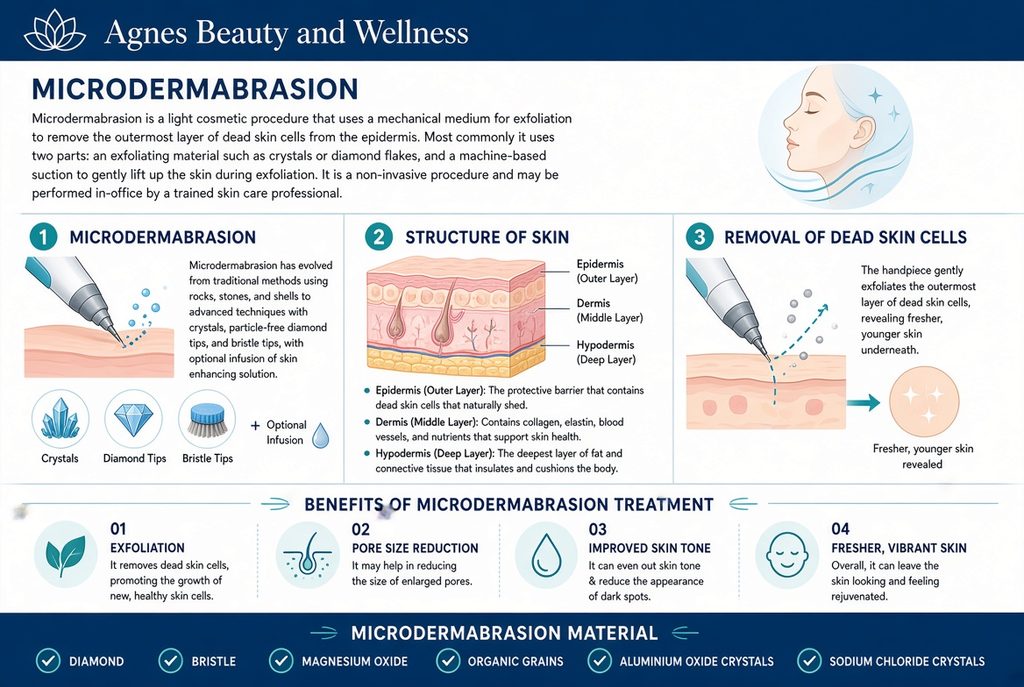
A medical microdermabrasion facial is a clinical-grade, non-invasive skin resurfacing treatment that uses a specialized handpiece to deeply exfoliate the outermost layer of dead skin cells — the stratum corneum — while adjustable vacuum suction pulls away debris and stimulates circulation. Unlike standard day-spa microdermabrasion, the medical-grade version runs on higher-powered equipment under the supervision of a licensed medical professional, like a dermatologist or cosmetic physician, allowing for deeper penetration and more aggressive cellular renewal.
One thing worth knowing up front: this is a medical procedure, and it's not something Agnes Beauty & Wellness performs. This guide exists because it's one of the most-searched skin treatments among people across Orange County and greater Los Angeles — and because Agnes offers several non-medical treatments that solve the same core concerns through gentler, esthetician-scope methods. More on that at the end. First, the full breakdown.
How Is a Medical Microderm Facial Performed?
A session typically runs 30 to 60 minutes, following a strict clinical protocol:
- Cleansing and degreasing — a liquid cleanser removes surface debris, followed by an alcohol-based degreasing solution that strips natural oils so the abrasive tip makes direct, uniform contact.
- Mechanical exfoliation — a diamond-tip wand or crystal handpiece glides across the skin in smooth, overlapping passes, physically abrading the stratum corneum while continuous vacuum suction pulls skin taut against the tip and removes debris.
- Extractions (if needed) — brief, targeted pressure clears congested pores immediately after the pass.
- Cooling and infusion — cold hyaluronic acid serums, soothing masks, or hydrating moisturizers are applied to calm the freshly exfoliated skin.
- Sun protection — a broad-spectrum physical sunscreen finishes the session, since freshly exposed skin is highly UV-sensitive.
The two main technologies:
- Diamond-tip wand — a head coated in natural diamond chips, offering precise control near delicate areas like the eyes and nose
- Crystal microdermabrasion — fine aluminum oxide or sodium bicarbonate crystals blasted onto skin and simultaneously vacuumed up, effective for uniform abrasion across heavily textured skin
What Does a Medical Microdermabrasion Facial Session Actually Feel Like?
Most patients describe it as non-invasive and virtually painless — a combination of mild scratching and firm, continuous suction, often compared to a cat's tongue dragging lightly across skin, or a small vacuum cleaner with a gritty nozzle.
- Cleansing phase — cool, evaporating, and slightly tightening as the degreasing solution is applied
- The pass itself — a steady, dull tugging from the vacuum as it pulls skin taut, paired with a fine-grit sandpaper sensation; can feel more intense over thin skin near the cheekbones, temples, and nose, though rarely sharp or painful
- Warmth — increased circulation from the suction creates a mild, localized warming sensation
- Cooling infusion — cold serums and masks applied immediately after create an instant, calming contrast
Immediately post-treatment, skin feels firm, squeaky clean, and slightly warm or flushed — similar to a mild windburn after a brisk walk in cold wind. That sensation typically fades within 1 to 3 hours.
Medical Microdermabrasion Benefits
Immediate:
- Instant radiance and smoother surface texture
- Enhanced topical product permeability — serums and actives absorb noticeably deeper afterward
- Pore decongestion and improved makeup application
Developed over a series of 4 to 8 sessions:
- Collagen and elastin stimulation from controlled micro-trauma
- Fading hyperpigmentation and superficial sun damage
- Softened fine lines
- Acne prevention and reduced superficial scarring
What it can't do: it doesn't reach deep wrinkles, sagging skin, or significant volume loss — those require deeper structural intervention entirely outside this treatment's scope.
Does Medical Microdermabrasion Actually Work?
Yes — provided expectations align with what the treatment can biologically achieve. Clinical studies confirm mechanical abrasion combined with vacuum suction produces real, measurable changes:
What the science supports:
- Reliable removal of the dead stratum corneum, immediately resolving dullness and rough texture
- Increased skin permeability, letting topical serums absorb significantly deeper
- Biopsy-confirmed increases in organized collagen density and epidermal thickening after a full series
- Breakup of uneven melanosome clusters, fading superficial sun damage and post-acne dark marks
Where it fails: it doesn't reach the deeper dermis or subcutaneous fat, so it can't lift jowls or fix significant elasticity loss. Deep ice-pick or boxcar acne scars need deeper modalities like fractional lasers or TCA cross. And it does not cure or improve active inflammatory acne — running an abrasive wand over cystic breakouts will worsen them.
The verdict: it's an excellent surface-refining and maintenance procedure for brighter skin, refined texture, and better product absorption with zero downtime. It's the wrong tool if the goal is major structural anti-aging correction or deep scar removal.
Medical Microderm for Hyperpigmentation, Acne Scars, and Enlarged Pores
This treatment performs well for non-inflammatory concerns: dullness, sluggish cell turnover, rough or uneven texture, congested pores, blackheads, superficial sun damage, and early fine lines. It's also considered one of the safest clinical resurfacing treatments during pregnancy, since it relies purely on mechanical exfoliation rather than systemically absorbed chemical acids or retinoids.
It performs poorly, or is outright contraindicated, for active inflammatory acne, deep ice-pick scarring, and any concern that lives below the epidermis rather than on its surface.
Medical Microdermabrasion Side Effects and Who Should Avoid It
Common, short-lived reactions (resolve in 24–48 hours): redness, tightness, dryness, mild sensitivity or stinging, and minor swelling.
Complications from improper technique or excessive suction: petechiae or bruising, visible "track mark" scratches or abrasion marks, post-inflammatory hyperpigmentation, and cold sore flare-ups in anyone with a history of HSV-1.
Absolute contraindications — do not treat:
- Recent isotretinoin (Accutane) use within the last 6 to 12 months — thinned skin risks tearing and permanent scarring
- Active inflammatory acne or cystic breakouts
- Active infections or cold sores (HSV-1)
- Open wounds, cuts, or recent facial surgery
Relative contraindications — proceed with caution or seek an alternative:
- Active rosacea or fragile capillaries
- Eczema, psoriasis, or severe dermatitis
- Blood thinners or prophylactic aspirin use
- Undiagnosed or changing skin lesions or moles — get these evaluated by a physician first
Medical Microdermabrasion vs. Spa Microdermabrasion — What's the Real Difference?
The core difference is equipment power and provider oversight, not the underlying technique. Medical-grade consoles offer significantly higher, more precisely adjustable vacuum suction than spa or at-home units, allowing deeper epidermal penetration — which is exactly why medical treatments require a licensed physician or supervised medical aesthetician, while spa-grade versions are performed by estheticians using gentler settings.
Medical Microdermabrasion vs. Dermaplaning, Peels, and Hydrodermabrasion
- Vs. dermaplaning — microdermabrasion uses physical grit and vacuum suction; dermaplaning uses a sterile surgical blade at a 45-degree angle to manually scrape away dead skin and fine vellus hair, with no suction involved.
- Vs. chemical peels — microdermabrasion is purely mechanical exfoliation; peels use acids to dissolve the bonds holding dead cells together, with no physical abrasion.
- Vs. wet hydrodermabrasion facials (the treatment category most people search alongside branded suction-facial names) — hydrodermabrasion pairs vacuum suction with liquid AHA/BHA solutions and a hydration infusion in the same pass, avoiding the dry, windburned finish that purely mechanical abrasion can leave behind.
What Patients Report — The Real Medical Microderm Reviews
Online patient reviews on skincare forums show high overall satisfaction, generally in the 85–95% range, with a clear split based on skin condition and operator skill.
What people consistently love: an immediate "baby smooth" texture that makes foundation apply seamlessly, noticeably clearer pores for anyone dealing with blackheads, a reliable pre-event glow 3 to 5 days before something like a wedding, and visibly better absorption of their existing skincare products afterward.
What people regret: the most common complaint by far is broken capillaries and visible spider veins from an inexperienced operator using excessive suction on thin or rosacea-prone skin. Others report active breakouts made worse when treated while inflamed, or scratch-like "track marks" from a wand dragged without holding skin properly taut. A smaller group report disappointment simply from expecting results — like erasing deep wrinkles or ice-pick scars — that this treatment was never capable of delivering in the first place. The consistent advice across patient communities: operator skill matters more than the machine, and anyone with rosacea or active breakouts should skip it entirely.
Questions to Ask Before Booking Medical Microdermabrasion in Orange County
Given the range of equipment power and operator skill involved, a short consultation should answer:
- Are you a licensed medical aesthetician, or under the direct supervision of a dermatologist or physician?
- Do you use a diamond-tip or crystal machine, and why for my specific skin type?
- Based on my skin type and current conditions, am I a safe candidate for vacuum exfoliation?
- How do you adjust suction level and grit to avoid broken capillaries or bruising on thin-skinned areas?
- What active ingredients or medications do I need to pause beforehand, and for how long?
- Does this session include extractions, LED therapy, or a soothing mask, or only the machine pass?
- What sanitization protocol do you follow for handpieces and tips between clients?
Preparing for Your Session and Aftercare
Before your appointment:
- Stop retinoids, retinol, AHA/BHA acids, and benzoyl peroxide for 3 to 5 days prior
- Avoid waxing, depilatories, or laser hair removal on the face for 5 to 7 days prior
- Avoid sun exposure for a full week beforehand; reschedule if you have an active sunburn or fresh tan
After your session:
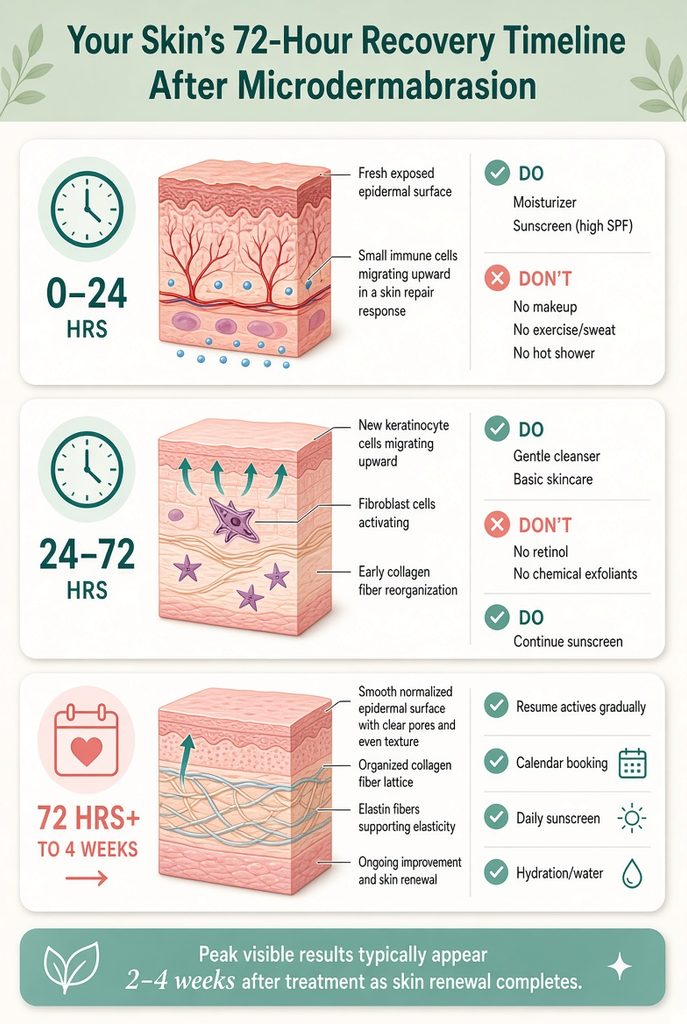
- No makeup for 12 to 24 hours — applying product into freshly cleared, open pores traps oil and bacteria and risks breakouts
- Avoid heavy exercise, saunas, or hot showers for the first 12 to 24 hours
- Use only gentle cleansers, hyaluronic acid, ceramides, and barrier-repair moisturizers for days 1 to 3
- Wear physical/mineral SPF 30+ daily — chemical sunscreens (avobenzone, oxybenzone, octisalate) can sting compromised skin
- Avoid public pools, hot tubs, or the ocean for at least 72 hours
- Gradually reintroduce active topicals only after days 5 to 7, once tightness and flaking fully resolve
Why Agnes Beauty & Wellness Doesn't Offer Medical Microderm — And What She Recommends Instead
This treatment requires medical-grade equipment and physician supervision, which places it outside an esthetician's scope of practice — and outside what Agnes's studio offers. What she does offer covers nearly the same ground, through gentler, non-medical methods:
If what draws you to medical microdermabrasion is the deep pore decongestion and instant smooth texture, the Korean O2 Facial delivers a comparable clean, plumped result through hyperbaric oxygen infusion — no abrasive suction at all.
If you're drawn to the hydration-plus-exfoliation combination, an Aqua Peel uses wet-vacuum suction paired with AHA/BHA solutions, avoiding the dry, windburned finish mechanical microdermabrasion can leave.
For smoother texture and an instant makeup-ready finish without any suction risk to fragile capillaries, the Deluxe Dermaplane Facial removes dead skin and fine vellus hair with a precise blade technique.
For surface renewal and light exfoliation without mechanical abrasion, BioRePeel Los Angeles offers a chemical alternative with zero downtime.
For clients further out in Los Angeles, mobile appointments are available on most of Agnes's menu — including her Customized Facial, BioRePeel, and DMK Enzyme Therapy — bringing the treatment to you rather than requiring the drive to Huntington Beach, for a $150 additional fee.
Not sure which treatment is best for you? Read my blog post on best facials in 2026 and compare facial treatments for different skin goals. Still not sure or want to speak to actual human being about it? Feel free to call me at 714-604-3449, I answer all your questions free and help you choose the best treatment for your skin.
Agnes Grumslys is a California Licensed Cosmetologist (License #A330955) with 15+ years of experience in facial treatments and skin revision at Agnes Beauty & Wellness in Huntington Beach — with mobile service available for clients in Orange County and Los Angeles, just 35 minutes away. Book a Korean O2 Facial or Aqua Peel alternative at Agnes Beauty & Wellness →
Frequently Asked Questions About Medical Microdermabrasion
What is a medical microdermabrasion facial?
A clinical-grade, non-invasive skin resurfacing treatment using a diamond-tip or crystal handpiece with adjustable vacuum suction to exfoliate dead skin, performed under the supervision of a licensed medical professional.
Does a medical microdermabrasion facial hurt?
No. It's non-invasive and virtually painless, though the vacuum suction and abrasive tip can feel intense over thin skin near the cheekbones or nose. Most patients describe it as similar to a firm scratching or buffing sensation, not sharp pain.
Is medical microdermabrasion safe for sensitive skin?
It depends. It's contraindicated for active rosacea, fragile capillaries, eczema, or active inflammatory acne. For genuinely sensitive or reactive skin, gentler alternatives like an oxygen facial or light enzyme exfoliation are generally the safer choice.
How is medical microdermabrasion different from spa microdermabrasion?
Medical-grade equipment offers significantly higher, more precisely controlled vacuum suction than spa units, allowing deeper epidermal penetration — which is exactly why it requires a licensed physician or supervised medical aesthetician rather than an esthetician alone.
How many sessions will I need to see results?
Most providers recommend an initial corrective series of 4 to 8 sessions spaced 2 to 3 weeks apart, followed by monthly maintenance sessions to align with skin's natural 28-day cellular turnover cycle.
Can I get medical microdermabrasion if I have active acne?
No. It's appropriate for non-inflammatory congestion like blackheads and whiteheads, but running an abrasive wand over active, inflamed, or cystic acne will burst lesions, spread bacteria, and worsen breakouts.
Does Agnes Beauty & Wellness offer medical microdermabrasion in Orange County?
No — this is a medical procedure requiring physician supervision, outside an esthetician's scope of practice. For similar results, Agnes recommends the Korean O2 Facial, Aqua Peel, or Deluxe Dermaplane Facial at her Huntington Beach studio. Mobile appointments are available on most of her menu for clients based in Los Angeles, just 35 minutes away, for a $150 additional fee. Book a Korean O2 Facial at Agnes Beauty & Wellness →